
 EN
How to Find Top Manual Ball Valve Producers Worldwide
Finding a capable Manual Ball Valve producer is not the same as finding the lowest online price. Global buyers need to compare a supplier’s ability to clarify operating conditions, make a repeatable configuration, provide the requested documents, and respond clearly before an order is released. For a water, chemical, oil, wastewater, or building-services project, that process protects the specification as much as the purchase order.
A Manual Ball Valve uses a hand-operated lever or gear mechanism to rotate a bored ball between open and closed positions. If you are still asking what is a ball valve, start with that function, then move to the features that change suitability: port design, body construction, seat material, end connection, pressure-temperature limits, and the actual medium. A valve name alone is not a complete specification.
Start With a Buyer’s Definition of the Required Manual Ball Valve
Before searching worldwide, write a short requirement sheet. A strong Manual Ball Valve inquiry does not begin with “send your catalog.” It states what the valve must do in the piping system and what the producer must confirm. This makes quotations comparable across regions and prevents a supplier from filling gaps with assumptions.
- Medium and concentration: water, air, gas, oil, slurry, or a process chemical can change the material and seat discussion.
- Pressure and temperature: state normal and possible upset conditions, not just a nominal line class.
- Size and connection: give nominal size, flange/thread/weld connection, face-to-face constraints, and mating standard where relevant.
- Flow and operating pattern: identify on-off duty, expected operating frequency, shutoff expectation, and whether full bore is needed.
- Material and sealing questions: request the body, ball, stem, seat, and seal materials rather than accepting an unqualified “stainless steel” description.
This list is useful whether you buy a small threaded Manual Ball Valve or a larger flanged unit. It also gives a producer a fair opportunity to say which points still need engineering confirmation.
Build a Worldwide Producer Longlist From Verifiable Signals
Use trade directories, regional industrial exhibitions, local sourcing partners, manufacturer websites, and referrals to create a broad longlist. At this stage, do not rank a Manual Ball Valve producer by website design or by a single marketplace listing. Instead, collect signals that can be tested during an RFQ.
| Signal to collect | Why it matters | What to request |
|---|---|---|
| Product scope | Shows whether the producer regularly handles the relevant valve family and connection types. | A current catalog plus the exact model series proposed for your Manual Ball Valve. |
| Specification response | Reveals whether technical questions are addressed instead of copied into a generic quote. | A completed data sheet with open items clearly marked. |
| Manufacturing traceability | Helps the buyer understand how materials, lots, and inspection records may be identified. | A sample inspection plan, traceability explanation, or redacted record format. |
| Quality-system evidence | Lets the buyer verify relevant claims rather than treating a logo as proof. | Current documents, issuing body details, scope, and product applicability. |
| Communication discipline | Reduces rework when drawings, revisions, and shipping marks change. | A named technical contact and revision-controlled quotation. |
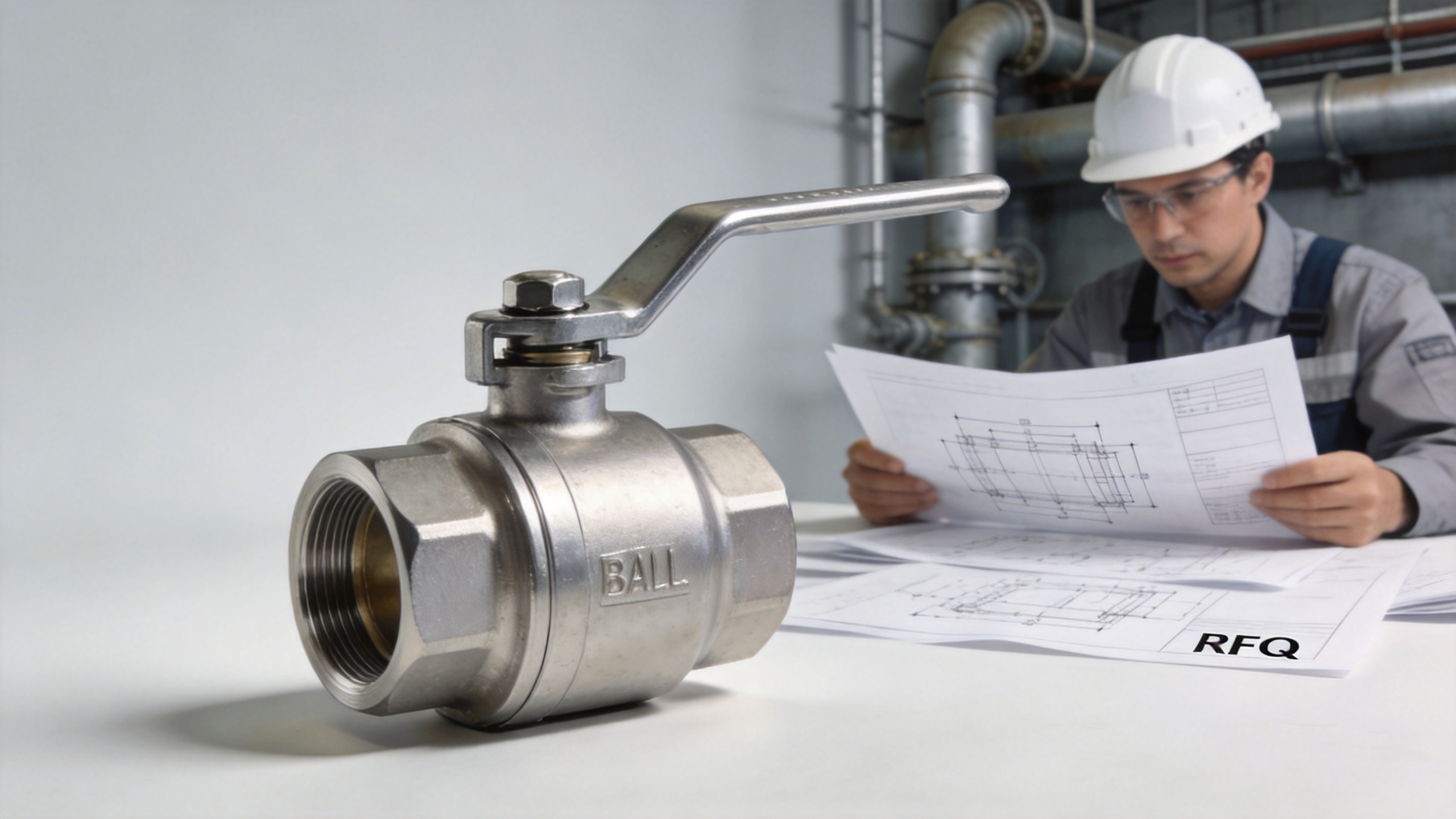
For a global Manual Ball Valve purchase, separate a producer’s stated capabilities from evidence supplied for the specific order. A document may be relevant to one design, material, or factory scope and not automatically to every item in a catalog.
Screen Producers With a Technical RFQ, Not a Generic Price Request
Send the same structured RFQ to the shortlisted Manual Ball Valve producers. Ask each company to identify deviations, unanswered fields, and recommended alternatives. The most useful response is often not the shortest lead time; it is the response that makes the scope visible.
- Ask for a model code and configuration breakdown for the proposed Manual Ball Valve.
- Request a dimensional drawing and a list of wetted and sealing materials.
- Ask how pressure testing, visual inspection, and marking are handled for the offered configuration.
- State any project-specific standard, end connection, or fire-safe requirement and request applicable evidence rather than a blanket statement.
- Confirm packaging, labeling, export documentation, Incoterms, production lead time, and inspection hold points.
Standards need the same care. Search findings indicate that API 607 concerns fire testing for soft-seated quarter-turn valves, including ball valves. That does not mean every Manual Ball Valve requires fire-test documentation, or that a general standard claim proves the exact valve is suitable. If fire performance is part of the project requirement, ask the producer which design and document apply, then review the answer with the project’s responsible engineering team.
Compare a Manual Ball Valve With a 6 Inch Butterfly Valve Fairly
A 6 inch butterfly valve can appear in the same sourcing conversation as a Manual Ball Valve, especially when a buyer is comparing quarter-turn isolation options. They should not be treated as interchangeable. The better choice depends on the medium, sealing requirement, line layout, pressure-temperature conditions, operating torque, and maintenance plan.
A Manual Ball Valve is commonly evaluated for straightforward quarter-turn shutoff and for configurations where ball, seat, and port geometry match the application. A 6 inch butterfly valve may be considered where its form factor and system requirements fit the line. Rather than asking which valve is more suitable,” ask each producer to explain why the offered design fits the stated conditions. That question is more likely to expose an unsuitable assumption before purchase.
Audit the Shortlist Before You Award the Order
Once two or three Manual Ball Valve producers remain, compare their answers against the same acceptance checklist. A lower quotation may not be lower in total effort if drawings arrive late, materials are not identified, or inspection expectations remain unclear. For international procurement, document control and response quality deserve a place beside unit price.
- Does the proposed Manual Ball Valve match the requested size, connection, body, ball, stem, and seat details?
- Are any substitutions, exclusions, or unconfirmed parameters stated in writing?
- Can the producer provide the documents your project genuinely requires, with scope and applicability checked?
- Can sample, pre-shipment inspection, or agreed hold points be planned before mass production?
- Do quotation revisions, drawings, and commercial terms identify the same configuration?
FOLS Valve focuses on industrial valves and automatic-control solutions for applications such as drainage, wastewater treatment, oil, chemicals, construction materials, and transportation. For a Manual Ball Valve discussion, the practical starting point is the application sheet: medium, pressure, temperature, connection, size, manual operating needs, and any documentation requirement. This keeps the conversation evidence-led rather than claim-led.
Use a Simple Producer Scorecard
Score every Manual Ball Valve producer against the requirements rather than relying on an overall impression. You might allocate points to configuration accuracy, document clarity, manufacturing and inspection transparency, responsiveness, commercial fit, and logistics readiness. Keep a separate “must confirm” column. An attractive score should not conceal an unresolved sealing material, pressure condition, or connection detail.
It is also sensible to use a trial order or sample review when the project allows it. The objective is not to prove that one Manual Ball Valve producer is universally superior. It is to confirm that the selected producer can reproduce the agreed specification and communicate deviations early.
Final Takeaway
A disciplined worldwide search process turns a broad list of Manual Ball Valve producers into a small group of suppliers whose answers can be verified. Define the duty first, issue a structured RFQ, compare documents and deviations carefully, and reserve final approval for the configuration that matches the real piping conditions. If you need help organizing a technical inquiry, begin with the operating data and the questions that still require confirmation.
 Hot News