
 EN
Where Should Diaphragm Valve Be Used In Biotech?
In biotech, a Diaphragm Valve is most useful where the process needs a cleanable flow path, dependable isolation, and a configuration that can be reviewed as part of a hygienic design package. That includes more than a single production skid. A Diaphragm Valve may sit on water-for-injection distribution, buffer preparation, media transfer, chromatography support lines, bioreactor connections, filtration manifolds, and sampling or drain points. The fit depends on the process duty, not simply on the word “biotech” in the project name.
From an application-engineering viewpoint, the practical question is whether a Diaphragm Valve helps the piping system avoid trapped process fluid while giving operations a clear way to isolate, control, clean, and document the point of use. A valve body, diaphragm material, end connection, and actuator must be assessed together. A hygienic-looking valve is not, by itself, evidence that a line is suitable for an aseptic process or that it has been validated.
Why a Diaphragm Valve fits hygienic biotech duties
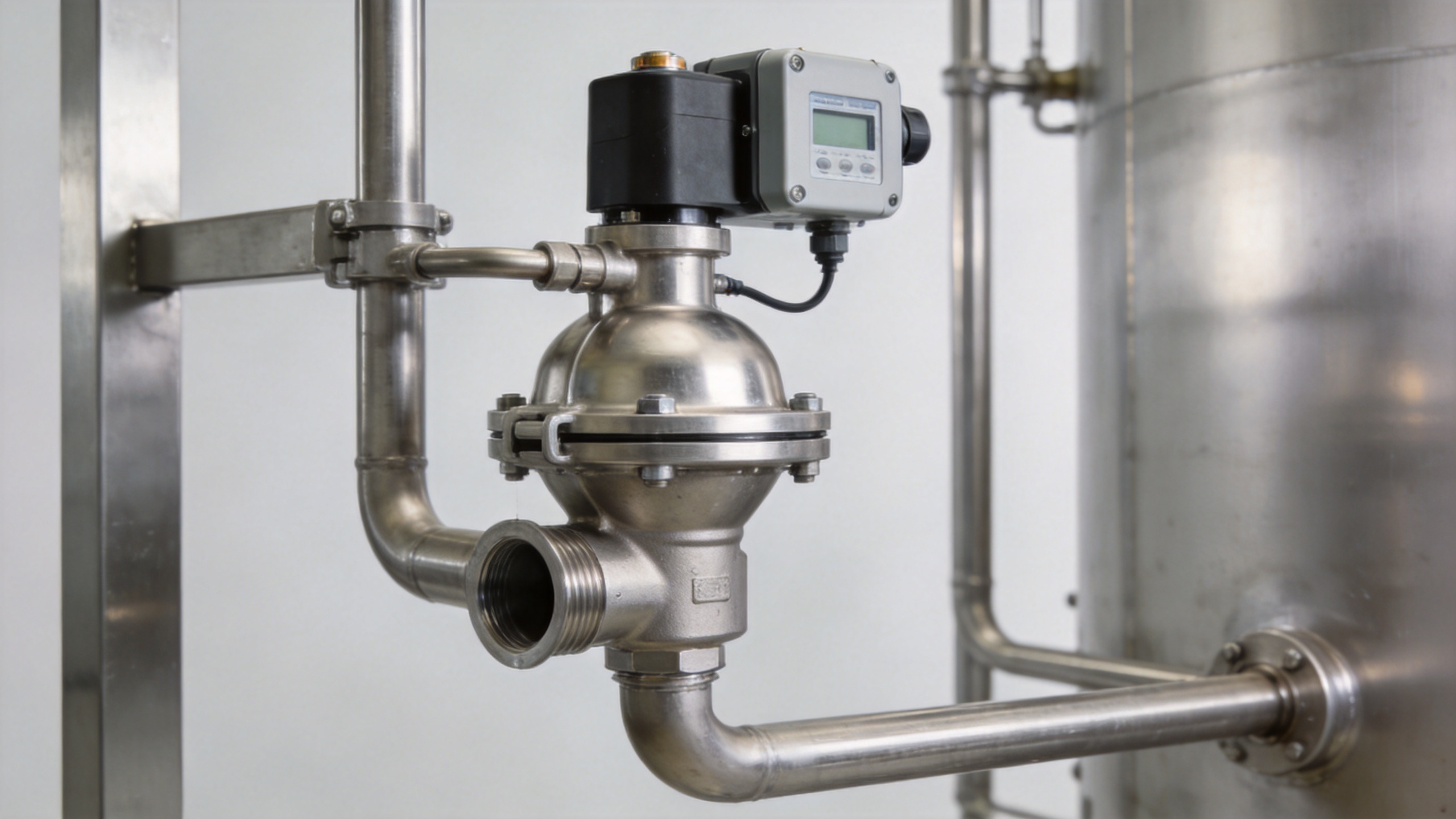
A Diaphragm Valve separates the operating mechanism from the wetted process area with a flexible diaphragm. In an appropriate hygienic configuration, that separation can reduce the number of places where process material or cleaning solution might be retained compared with valve arrangements that introduce a more complex internal cavity. It is especially relevant when operators need frequent cleaning-in-place or sterilization-in-place cycles, provided the specified materials, surface condition, and operating limits have been reviewed for the actual cycle.
The strongest use case is not “all clean fluids.” It is a process point that needs repeatable shutoff or controlled flow, a drainable layout, and a documented material-and-maintenance plan. A Diaphragm Valve can be a sound choice for purified-water branches, buffer and media routing, upstream or downstream utility interfaces, and vessel-associated connections where piping geometry has been designed with the valve in mind.
Common biotech locations to evaluate
1. Water, buffer, and media preparation systems
Preparation skids often have many short transfer paths, tank connections, and branches that are cleaned between batches. A Diaphragm Valve is worth evaluating at isolation points, distribution branches, and drainable takeoffs when the selected body geometry supports the intended piping slope and cleaning flow. Start with the medium, temperature, pressure, cleaning chemistry, and cycle frequency. Then confirm the diaphragm compound and body specification against those conditions.
2. Bioreactor and seed-train connections
A Diaphragm Valve can be considered for gas, liquid, sampling, addition, harvest, and utility connections around bioreactors. These are not interchangeable duties: a sampling point may prioritize a short, drainable connection, while a feed line may prioritize cycle life and response time. For each point, review whether the valve creates an avoidable stagnant branch, whether it can be cleaned in the installed orientation, and how diaphragm replacement will be controlled in maintenance records.
3. Filtration, chromatography, and product-transfer manifolds
Manifolds change configuration frequently, so a Diaphragm Valve can help make individual routes easier to isolate and identify. The correct arrangement still depends on the process map. Verify the pressure and flow range, the risk of hold-up volume, the connection standard, and the need for manual versus automated sequencing. Where product recovery matters, confirm the full assembly layout rather than treating the valve as an isolated component.
4. Point-of-use branches and low-point drainage
In distribution systems, a Diaphragm Valve may be appropriate at a point of use, a drain location, or a vessel outlet when the body style and installation geometry support drainage. Published hygienic-process guidance discusses zero-static tees, tank-bottom arrangements, and radial diaphragm layouts as ways to reduce stagnant areas. The useful lesson is not to copy a layout blindly: check elevation, line slope, branch orientation, and cleaning coverage on the actual P&ID and isometric drawing.
How to choose the right Diaphragm Valve configuration
Selection should move from process conditions to the valve configuration. A practical review can use this order:
- Define the duty: Is the Diaphragm Valve isolating, throttling, diverting, sampling, draining, or protecting a sterile boundary?
- Map cleanability: Review dead-leg exposure, drainability, welds, connection orientation, and access for inspection.
- Match wetted materials: Check the diaphragm, body material, seals, and surface requirements against media, cleaning chemicals, temperature, and sterilization conditions.
- Choose control deliberately: A manual valve can be appropriate for infrequent, visible operations. A pneumatic manual control valve arrangement may combine local manual capability with a pneumatic actuator only when the operating philosophy and failure position support it.
- Review the automation loop: For automated sequencing, confirm instrument-air quality, actuator feedback, control signal requirements, and how pneumatic solenoids are specified, protected, and maintained.
- Request evidence: Ask for drawings, material traceability, diaphragm data, surface-finish information where required, and documents relevant to the project specification.
Do not treat a pneumatic manual control valve as a generic upgrade. If the valve is hard to reach, repeatedly actuated, or part of an interlocked clean-in-place sequence, automation can be useful. If an operator must visually verify a low-frequency activity, a simpler manual arrangement may be more suitable. Pneumatic solenoids should be evaluated as part of the control architecture, including enclosure conditions, pilot air, response expectations, and maintenance access.
What a Diaphragm Valve does not solve
A Diaphragm Valve cannot correct a poorly routed line, unsuitable cleaning recipe, or undocumented material change. It also cannot substitute for a project’s qualification work. The valve should be reviewed with the process engineer, piping designer, automation team, quality group, and maintenance team. That cross-functional review is where nominal size, end connection, body geometry, actuation, feedback, and documentation become a usable specification rather than a catalog selection.
A short specification checklist
Before releasing a Diaphragm Valve for a biotech project, record the process medium; pressure and temperature range; valve function; drainability expectations; body and diaphragm materials; end connections; cleaning and sterilization exposure; actuator type; fail position; feedback requirement; pneumatic solenoids and air requirements; required drawings; and replacement-diaphragm plan. For applications governed by hygienic design requirements, compare the requested construction and documentation with the project’s stated standard rather than assuming compliance from a product label.
Bottom line
Use a Diaphragm Valve in biotech where cleanability, controlled isolation, and drainable piping geometry are central to the process duty. It is often a strong candidate for water, buffer, media, vessel, manifold, sampling, and drain applications, but only after the system layout and validation needs have been checked. The right choice is the Diaphragm Valve configuration that fits the real process conditions, cleaning regime, control philosophy, and documentation plan.
 Hot News