
 EN
What Makes Diaphragm Valve Essential For Purity?
In a purity-sensitive line, a valve is more than a way to start and stop flow. It is part of the contamination-control strategy. A Diaphragm Valve is often considered when a process needs a clear separation between the operating mechanism and the wetted path, plus a geometry that can be evaluated for cleaning and drainage. For pharmaceutical utilities, food and beverage systems, laboratory water, cosmetics, and carefully controlled chemical service, that combination can matter as much as flow capacity.
From an industrial-valve application engineer’s perspective, the useful question is not whether every Diaphragm Valve is automatically suitable for a high-purity duty. The better question is whether its body design, diaphragm material, surface condition, installation orientation, and control method fit the actual medium, pressure, temperature, cleaning method, and validation plan. Purity is achieved by the system and its operating discipline, not by a valve name alone.
Why the sealing principle supports a cleaner flow path
A Diaphragm Valve uses a flexible diaphragm to isolate the process fluid from the stem and actuator side of the valve. In a typical weir design, the diaphragm presses onto a raised seat to close the passage. That arrangement removes the need for a moving stem to pass through the wetted zone, which can simplify the boundary that must be inspected and maintained.
This is important where leakage, trapped residue, or hard-to-access crevices create quality concerns. A properly specified Diaphragm Valve can give engineers a compact isolation point whose wetted materials and connection details can be reviewed as part of the piping design. The value is not simply “leak-tightness”; it is the ability to identify the product-contact boundary and assess it against the process risk.
Cleanability still depends on execution. FDA guidance for aseptic processing emphasizes surfaces that are smooth, hard, and readily cleaned. That general principle translates into practical questions for any Diaphragm Valve: Is the selected material compatible with the cleaning chemistry? Can the valve drain in its installed orientation? Are the welds, clamps, gaskets, and upstream branches included in the same review?
Dead legs and routing: where purity risks can hide
Purity problems often develop in the spaces around a valve rather than at the visible actuator. A short unused branch, a poorly oriented tee, or an arrangement that cannot be drained may retain liquid after a batch, rinse, or sanitization cycle. Those retained zones deserve the same attention as the Diaphragm Valve itself.
A 3 way diaphragm valve can be useful when the process must divert, sample, drain, or choose between two routes while limiting unnecessary branch connections. The benefit depends on the actual flow path. Instead of assuming that any three-port arrangement is cleanable, review the body drawing, seat locations, port orientation, hold-up areas, and the clean-in-place sequence. Multi-port configurations may reduce improvised piping branches, but they must still be validated in the installed system.
For a Diaphragm Valve at a low point, high point, or branch connection, ask where liquid goes after shutdown. Then ask how cleaning solution and rinse water reach each wetted surface. This thought process catches issues that a catalog comparison can miss. If the medium and pressure conditions are stable, that comparison is usually useful; when the process changes, the valve selection should be reviewed again.
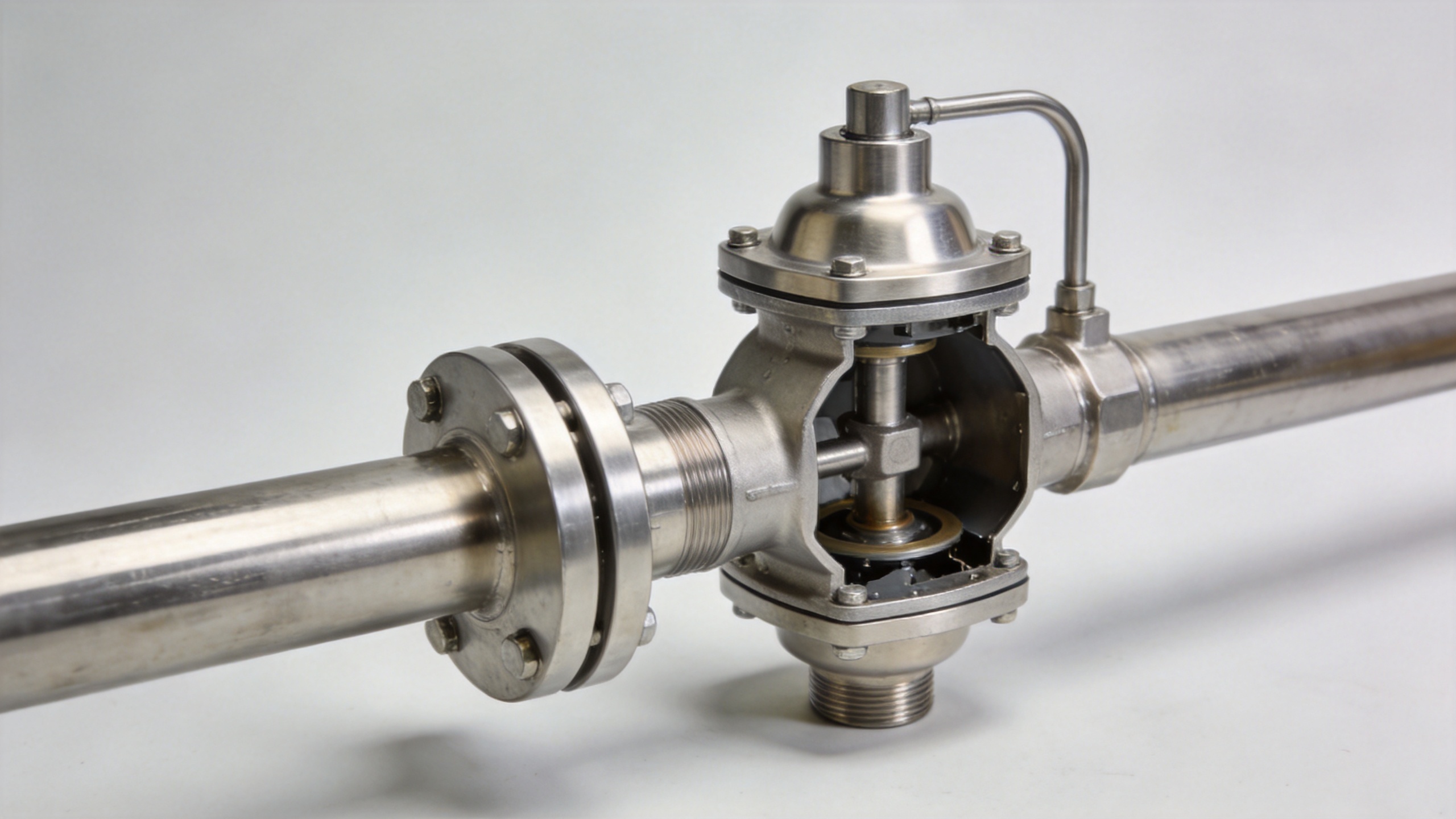
Material compatibility is part of purity control
The diaphragm is a critical product-contact component in a Diaphragm Valve. Its polymer or elastomer formulation should be assessed for the process fluid, operating temperature, pressure, sterilization method, cleaning agents, and cycle frequency. A material that handles one water-based service may not be suitable for a solvent, an oxidizing cleaner, hot steam, or repeated thermal cycles.
Body material and surface condition also matter. Stainless steel grades, internal finish expectations, connection style, and gasket choices should be documented in the project specification rather than inferred from a general product category. Where a project uses ASME BPE as a design reference, the team should define the applicable clauses, documentation, and acceptance criteria before ordering. Mentioning a standard is not a substitute for confirming the required configuration.
Maintenance completes the materials discussion. Diaphragms age, and their service life depends on conditions. A Diaphragm Valve maintenance plan should define inspection triggers, replacement intervals based on process evidence, torque or closure procedures where applicable, and records that support traceability. The aim is to identify deterioration before it affects a controlled process.
Choosing the right control method without compromising the process
Manual operation may fit a low-frequency point that is easily accessible and governed by a clear procedure. Pneumatic or electric actuation may be more appropriate when a Diaphragm Valve must be sequenced, remotely controlled, or returned to a defined state during an alarm. In either case, review the actuator-to-valve connection, available instrument air or power, signal type, fail position, closing speed, and accessibility for maintenance.
It is also useful to separate purity duties from compressed-air duties. A pressure valve for air compressor is selected to manage pneumatic-system pressure and safety behavior; it is not automatically interchangeable with a process isolation valve. When instrument air drives a pneumatic Diaphragm Valve, specify both components for their own functions: clean, dry air quality for the actuator and suitable wetted materials and geometry for the process side.
Speaking of control, the issue is not only the valve body. The actuator, tubing, solenoid arrangement, feedback device, and installation environment must work together. A technically suitable Diaphragm Valve can still create operational risk if its control package cannot be tested, serviced, or returned to a safe state consistently.
A practical purity review before purchase
Before finalizing a Diaphragm Valve, bring process, quality, maintenance, and automation stakeholders into the same specification review. A concise checklist is more useful than a generic claim about sanitary performance:
- Define the medium, concentration, temperature range, pressure range, flow direction, and required shutoff behavior.
- Map each Diaphragm Valve location for drainability, branch geometry, access, and cleaning coverage.
- Confirm diaphragm, body, seal, and connection compatibility with product, cleaning chemistry, and sterilization exposure.
- For a 3 way diaphragm valve, review every operating position and the flow path during cleaning, draining, and changeover.
- Specify actuator power, fail position, feedback, and test requirements separately from process-wetted requirements.
- Set acceptance records: material certificates where required, surface expectations, pressure testing, cleaning validation inputs, and spare-diaphragm controls.
In procurement discussions, clarifying the duty and interfaces early usually reduces later rework. Guangzhou Fols Valve Technology supports industrial valve and automation conversations, but the final selection should be based on the documented process conditions and the project’s quality requirements.
When a diaphragm valve is the right answer
A Diaphragm Valve is essential for purity when its isolated operating mechanism, controllable wetted path, maintainable diaphragm, and cleanable installed geometry directly address the process risks. It is not a universal answer for every medium or pressure class. The strongest choice is the one that can be traced from the process specification through installation, cleaning, testing, and maintenance.
Start with the contamination risks, then verify the physical details. By treating the Diaphragm Valve as one part of a complete sanitary design rather than an isolated component, teams can make a more defensible decision about purity, uptime, and long-term process control.

 Hot News

