
 EN
How Does Electric Butterfly Valve Manage Large Flows?
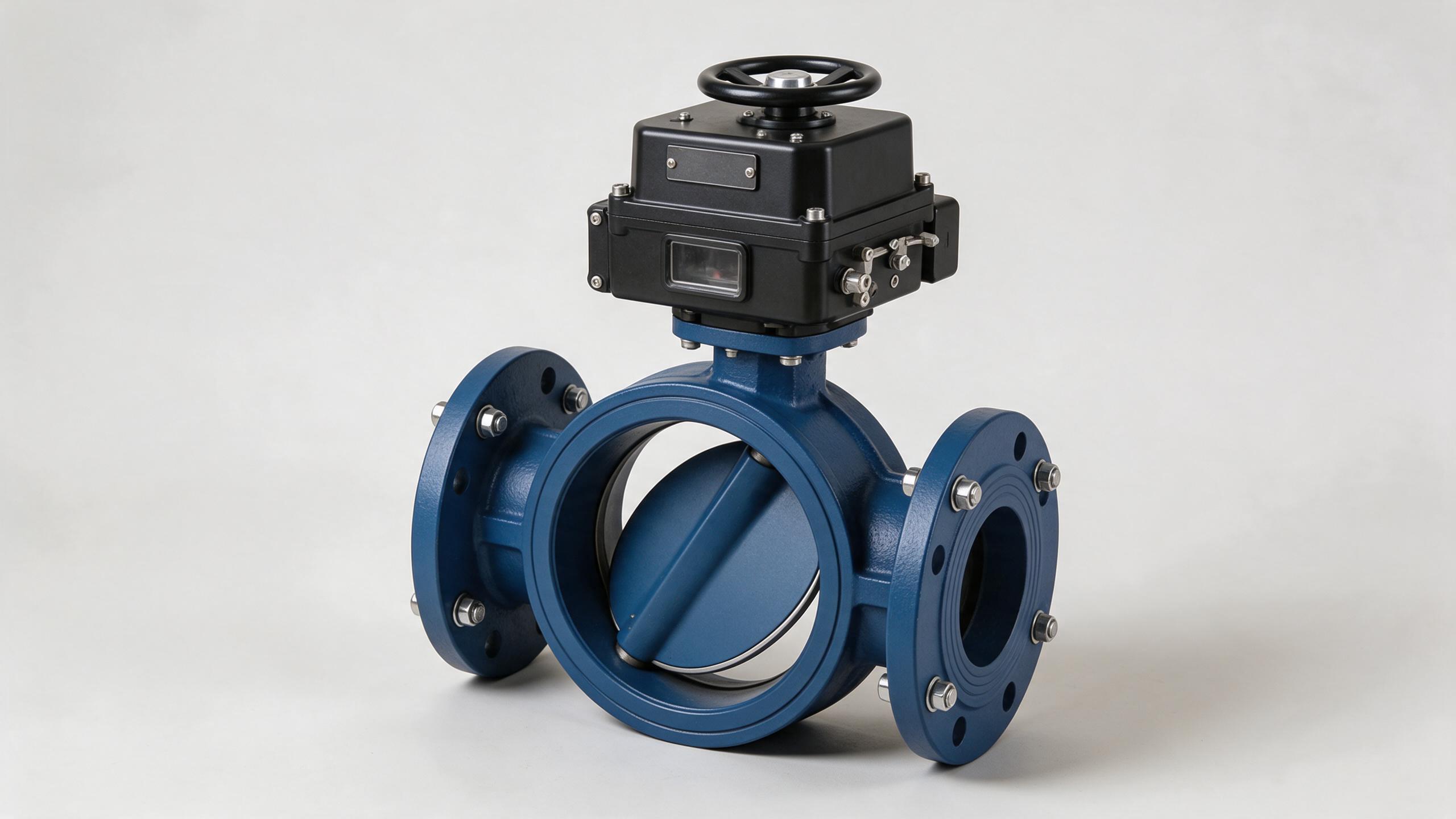
An Electric Butterfly Valve manages a large flow by combining a low-profile rotating disc with an actuator that positions the disc for the required duty. The useful question is not simply whether an Electric Butterfly Valve has the same nominal size as the pipe. It is whether its flow coefficient, pressure loss, disc position, seat materials, and actuator torque fit the actual system.
From an automation-control perspective, the valve body, electric actuator, power supply, control signal, and process conditions form one control chain. A large line may need fast isolation, repeatable partial opening, or both. Those duties call for different checks. An Electric Butterfly Valve can be a practical route to remote operation in water treatment, building services, process lines, and utility systems, provided the selection is based on operating conditions rather than a product name alone.
Why the disc design suits high-capacity lines
Inside an Electric Butterfly Valve, a disc turns around a shaft. Near the open position, the disc presents a relatively small obstruction compared with many multi-turn valve arrangements. That compact quarter-turn motion lets the actuator move from closed to open through a short travel range. In a large pipeline, this can reduce the mechanical travel needed for remote operation and leave more installation clearance than a bulky rising-stem arrangement.
Capacity still has a boundary. The disc and stem remain in the flow path, so they create pressure loss. The relevant catalogue value is normally a flow coefficient, stated as Cv or Kv under defined conditions. A larger nominal diameter often has a higher available coefficient, but it does not prove that the valve will pass the required flow at the permitted pressure drop. For an Electric Butterfly Valve, compare the manufacturer’s published coefficient at the intended opening angle with the process flow, fluid properties, and available differential pressure.
Large flow is not the same as stable control
A fully open Electric Butterfly Valve used for on/off isolation is assessed differently from one that regulates a changing flow. In isolation service, engineers usually check the open pressure loss, the maximum differential pressure during closing, and the required shutoff performance. In modulating service, the target is a useful relationship between actuator position and flow over the working range.
Disc angle matters because the flow passage changes rapidly through parts of the rotation. A valve selected only for wide-open capacity may spend normal operation near a small-angle position, where control can be less manageable. Conversely, a valve selected for a defined control range may not be the same nominal size as the line. The Electric Butterfly Valve should therefore be sized from the duty point and the supplied characteristic curve, not automatically from pipe DN or NPS.
This is also where a hot water balancing valve has a different job. A balancing valve is normally selected to establish or verify a planned hydronic flow distribution. An Electric Butterfly Valve may isolate or modulate a larger branch, but it does not replace the balancing method required by the system design. If hot-water control is involved, confirm design flow, temperature range, differential pressure, and the control sequence together.
How electric actuation keeps the disc usable
The actuator turns the shaft to a commanded position. For a two-position Electric Butterfly Valve, the command may be open or closed. For a modulating Electric Butterfly Valve, the actuator also needs a compatible control signal, feedback arrangement where required, and a selected response time. These details determine whether the system can repeat a position rather than simply move the disc.
Torque selection deserves equal attention. Seating and unseating force, friction at bearings and seals, flow forces on the disc, and differential pressure can all affect the torque demand. The actuator must be checked against the valve manufacturer’s torque data at the maximum applicable differential pressure and temperature, with the planned operating frequency included. Do not assume that an actuator chosen from valve size alone can close every Electric Butterfly Valve under the project’s worst operating condition.
Installation also affects real behavior. Nearby elbows, reducers, pumps, and other disturbances can change the velocity profile reaching the disc. In a modulating application, allow for straight-run guidance and installation instructions in the selected product documentation. A large-flow Electric Butterfly Valve is part of the pipe system, not an isolated component.
Five checks before selecting an Electric Butterfly Valve
- Define the fluid. Record liquid, gas, slurry, or mixed-medium details; temperature; solids; corrosion concerns; and changes expected during operation. These affect body, disc, stem, and seat choices.
- Set the flow and pressure envelope. State normal, minimum, and maximum flow, inlet and outlet pressure, allowed valve pressure loss, and maximum differential pressure for shutoff.
- Separate duty types. Identify whether the Electric Butterfly Valve is for isolation, throttling, or a combination. Ask for the relevant coefficient and characteristic data for that duty.
- Match the actuator. Confirm voltage, control signal, fail-position requirement, operating time, duty cycle, enclosure needs, and torque at the stated conditions.
- Check connections and installation details. Verify end connection, face-to-face space, mounting standard, pipeline layout, and access for commissioning and maintenance.
Where adjacent valve terms can mislead a selection
Related keywords do not automatically identify an interchangeable valve. A vacuum gate valve is designed around vacuum isolation requirements and may be evaluated for leakage, materials, and actuation in a very different environment. Calling for a vacuum gate valve when the duty is high-volume process-water control, for example, can divert the discussion from the pressure, medium, and control conditions that should drive an Electric Butterfly Valve selection.
Likewise, an Electric Butterfly Valve is not defined by electric actuation alone. A correct inquiry links the body style and seat to the medium, then links valve torque and travel to the actuator. This system view avoids a common procurement problem: comparing quotations before the connection type, pressure boundary, control requirement, and electrical connection are consistent.
A practical conclusion for large-flow service
An Electric Butterfly Valve manages large flows through its rotating-disc geometry and short-travel electric actuation, but dependable performance comes from application-specific sizing. Start with required flow and allowed pressure loss, then verify the published Cv or Kv data at the working position. Next, confirm close-off differential pressure, torque, materials, control signal, and installation conditions.
For project discussions, prepare a short data sheet with medium, pipe size, flow range, pressure and temperature range, connection standard, control mode, power supply, and fail-position expectation. With those items defined, an Electric Butterfly Valve can be evaluated as a controlled part of the complete piping system rather than as a generic large-flow component.
 Hot News





