
 EN
Where Should Pneumatic Ball Valve Be Installed First?
The first Pneumatic Ball Valve should usually serve the process point where rapid, repeatable isolation has the clearest operating consequence and the supporting conditions have already been confirmed. That may be a vessel outlet, a branch feeding a critical skid, or the inlet to a treatment stage. It is not automatically the first valve after a pump, the nearest valve to a compressor, or the largest line on the drawing.
From an industrial valve application engineer’s viewpoint, a Pneumatic Ball Valve belongs in a decision sequence: define the medium and process consequence, confirm the valve and seat materials, then verify the actuator, air supply, controls, and maintenance access. A quarter-turn ball valve can automate on/off duty efficiently, but its location still has to support the wider piping system.
Start with the highest-consequence isolation point
For a new automated line, install the first Pneumatic Ball Valve at the point where an on/off action most clearly protects a process step, enables planned isolation, or prevents an unwanted transfer. Typical candidates include the feed branch to a batch vessel, the outlet of a tank before a downstream operation, or a line that must be isolated before maintenance. The correct candidate depends on the process design, not on a generic upstream-versus-downstream rule.
Rank possible locations by asking three questions. What happens if flow continues when the system should be isolated? Who needs the line available after shutdown? Can the valve be accessed, inspected, and serviced without creating another isolation problem? The first Pneumatic Ball Valve should be the location with a meaningful duty and a workable answer to all three.
Do not place a Pneumatic Ball Valve where closure could interfere with a pressure-relief, venting, drain, or other protective function unless the approved process design specifically permits that arrangement. This is a design-review issue, not a product preference. Confirm the line function and applicable site requirements before finalizing the location.
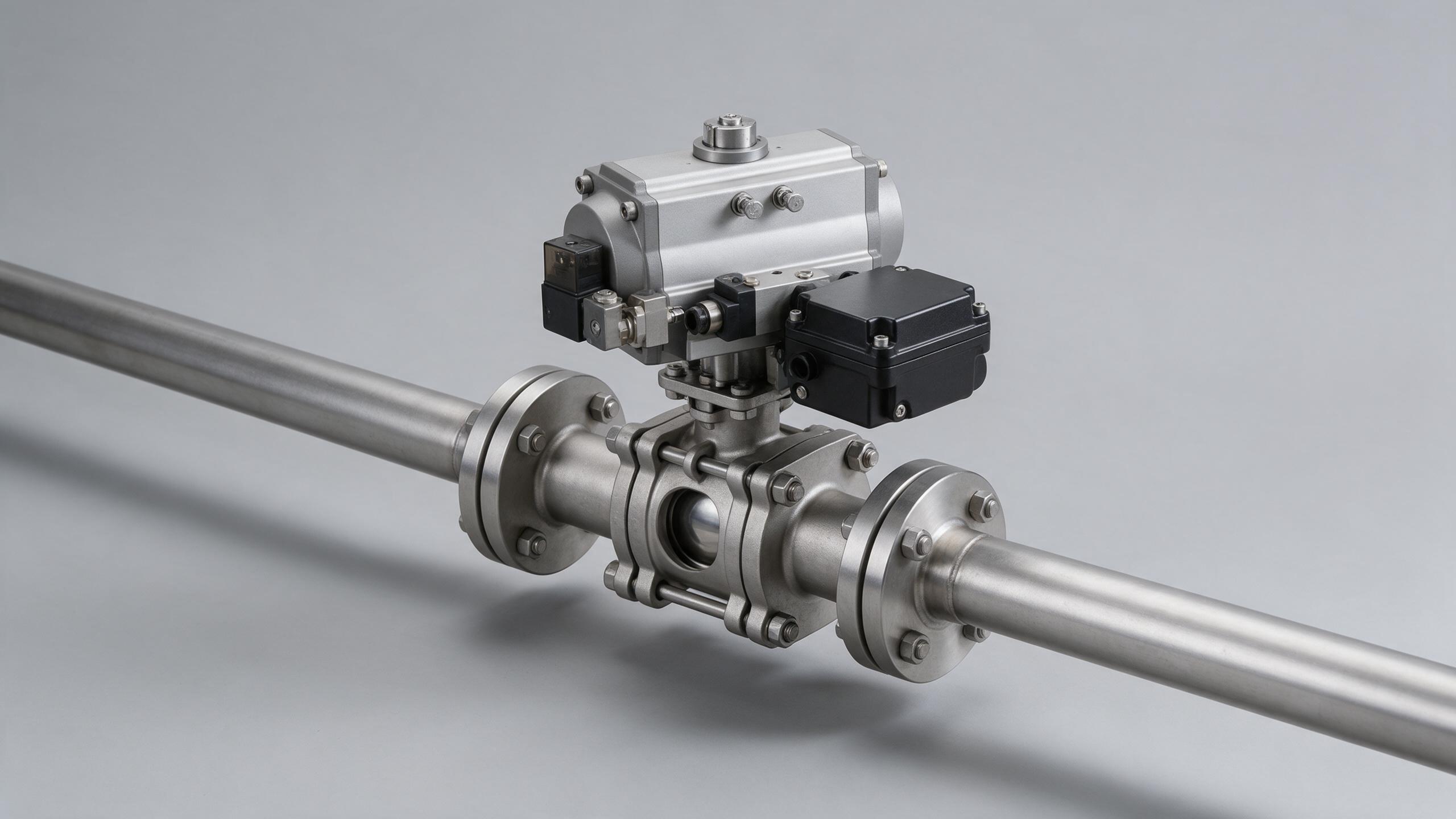
Confirm the process before choosing the valve location
A Pneumatic Ball Valve is normally considered for defined on/off isolation, so begin with the medium, pressure, temperature, line size, solids content, and expected cycling frequency. Those details influence body material, seat selection, connection method, actuator torque, and the amount of clearance required around the assembly.
Do not first ask whether a ball valve or butterfly valve is better. First write down the medium, operating limits, and control objective. Looking at types of butterfly valves can be useful when comparing an adjacent isolation point or a larger pipe size, but it does not make a butterfly valve a substitute by default. A Pneumatic Ball Valve should be selected only after the shutoff requirement and system limits are understood.
For example, a clean utility line that needs frequent remote on/off action may justify a Pneumatic Ball Valve near the equipment inlet. A line with abrasive solids, unusual viscosity, or a need for throttling requires a separate suitability review. The product name alone does not answer those questions.
Make actuator behavior part of the first installation decision
The actuator changes the installation priority. Before fitting the first Pneumatic Ball Valve, decide what state the process needs if instrument air or the control signal is lost. A spring-return actuator can be configured to move toward a selected fallback state, while a double-acting arrangement needs its loss-of-air behavior assessed with the system design. Neither choice is universally right; the required state depends on the process hazard and operating procedure.
Then verify air quality, available pressure, tubing route, solenoid arrangement, feedback requirement, and local manual override. A Pneumatic Ball Valve at a critical point is only as useful as the air and control path that commands it. If an RFQ mentions a burkert solenoid valve, treat that as a component-compatibility question: verify voltage, porting, enclosure, signal logic, and documentation against the selected actuator and site rules rather than assuming interchangeability.
Choose a location that can be commissioned and maintained
The first Pneumatic Ball Valve is also a practical trial of the installation standard for the rest of the line. Leave enough space to inspect the actuator, remove it where the product design permits, reach fittings, read position indication, and operate any manual override. Avoid placing the assembly where condensate, washdown, heat sources, or a crowded pipe rack make routine checks unnecessarily difficult.
Check that the pipe supports carry the piping load rather than loading the Pneumatic Ball Valve and actuator. Confirm flange or threaded alignment, flow direction where applicable, electrical and pneumatic cable routing, and the availability of upstream and downstream isolation needed for maintenance. One isolated valve rarely solves every maintenance scenario; the line arrangement must support the full procedure.
A practical order for first installation
- Map the isolation duties. List locations where remote closure affects safety, product transfer, cleaning, maintenance, or batch control.
- Rank consequences. Select the duty where uncontrolled flow or delayed isolation has the clearest impact and where the process design supports automated closure.
- Confirm the valve basis. Match the Pneumatic Ball Valve body, seat, connection, pressure-temperature range, and torque requirement to actual operating conditions.
- Define the failure state. Record whether the selected Pneumatic Ball Valve should fail open, fail closed, or retain position, then validate that decision with the process team.
- Validate the support system. Check instrument air, filtration, solenoid logic, feedback, emergency procedure, and physical access before installation.
- Commission the first assembly. Stroke the Pneumatic Ball Valve, verify indication and command response, inspect for leakage under approved conditions, and document the result before repeating the layout elsewhere.
When not to make it the first automated valve
Delay a Pneumatic Ball Valve installation when the medium compatibility, pressure-temperature envelope, actuator torque, or failure-state requirement is still unknown. It is also sensible to defer the location if the piping drawing has not established safe isolation for maintenance. Installing hardware before those answers are available can create rework and obscure the real system decision.
In some facilities, the first automation effort may instead belong at an instrumented control point, a manually operated maintenance isolation point, or a different valve type. A Pneumatic Ball Valve is a strong candidate for fast on/off duty, but it is not a blanket answer for regulating service or every line condition.
Final checklist for the first Pneumatic Ball Valve
- Is the chosen point tied to a clear isolation or transfer duty?
- Are medium, pressure, temperature, connection, and cycle expectations documented?
- Does the required fail state match the approved process response?
- Are air supply, pilot components, controls, and feedback compatible?
- Can technicians safely reach and isolate the Pneumatic Ball Valve for inspection?
- Has the commissioning plan defined what will be tested and recorded?
Install the first Pneumatic Ball Valve where it proves an approved operating function, not merely where it is easiest to pipe. Once that location, actuator behavior, and commissioning method are confirmed, the same condition-led approach can be applied to the remaining automated isolation points.
 Hot News





