
 EN
What Makes Globe Valve Ideal For Thermal Systems?
In a thermal loop, a Globe Valve is worth considering when the process needs more than an open-or-closed path. Heating-water coils, heat exchangers, steam users, and temperature-sensitive branches often need flow to change in small, repeatable increments. A properly selected Globe Valve gives the actuator a linear travel path and the trim a defined relationship between lift and flow. That can help, but it is not a shortcut: the same Globe Valve can be a poor fit when pressure loss, flashing, noise, or isolation duty is the real design driver.
Why thermal control favors a Globe Valve
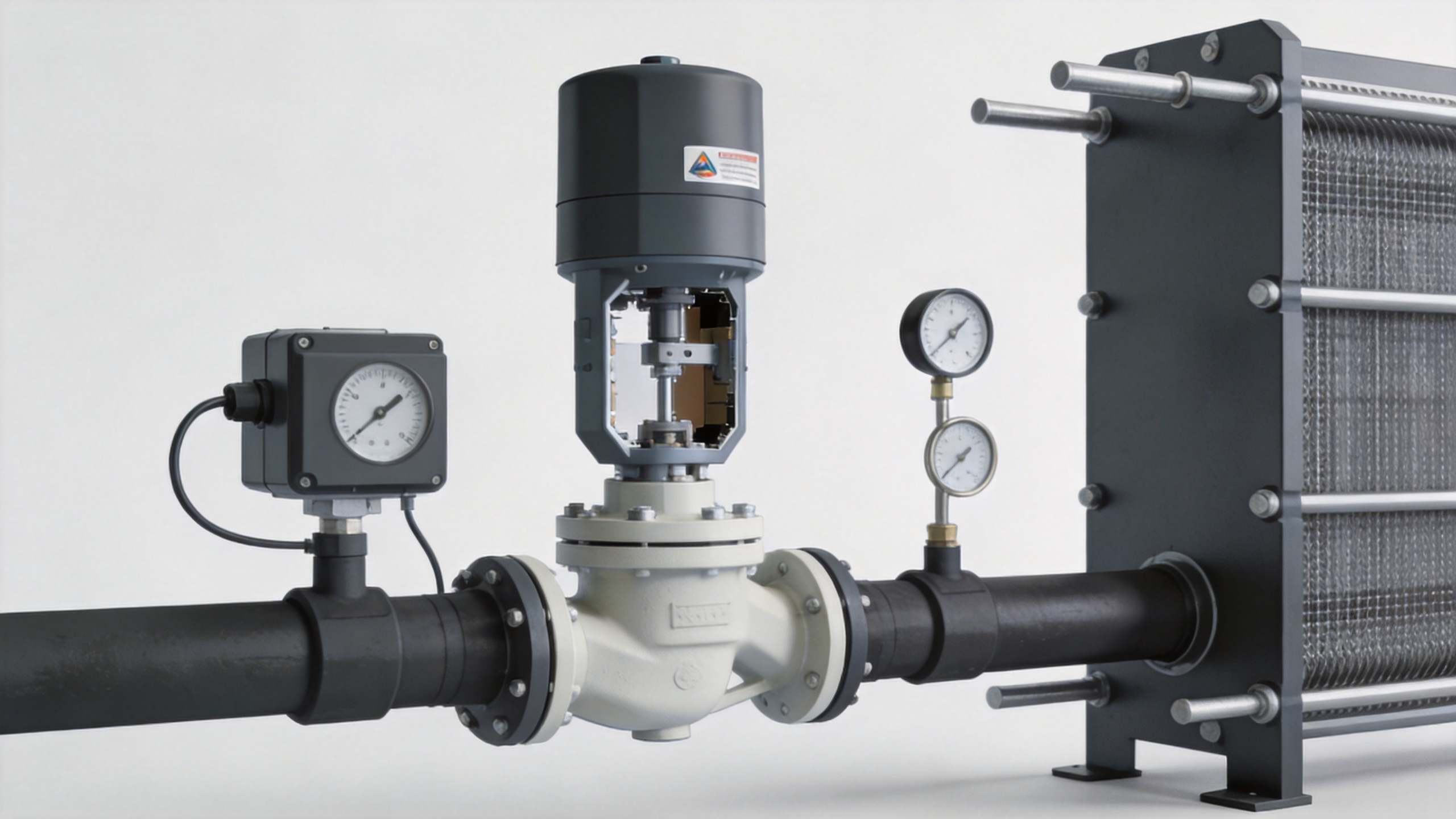
A thermal system controls energy by controlling the mass flow of steam, hot water, chilled water, or heat-transfer fluid. The plug and seat arrangement of a Globe Valve is built for throttling rather than simply clearing the bore. As the stem moves, the flow area changes in a controlled way. With suitable trim, the valve can offer an inherent flow characteristic that the controls engineer can relate to loop demand.
This matters at a coil or heat exchanger. If a Globe Valve moves a little and the circuit flow changes far too much, temperature hunts. If it moves and produces almost no useful change, the actuator spends much of its travel without control effect. A correctly sized Globe Valve helps place usable modulation across the operating range instead of concentrating it near one end of the stroke.
Three system conditions to check first
1. Required control range and valve characteristic
Start with minimum, normal, and design flow—not pipe diameter alone. A Globe Valve with linear, equal-percentage, or other available trim should be considered alongside the heat-load profile and the control sequence. Equal-percentage behavior is often considered where the pressure drop across the valve changes through the operating range; the appropriate choice still depends on the full loop calculation and the manufacturer’s published data.
2. Pressure drop and control authority
A Globe Valve needs enough differential pressure to influence flow, while excessive valve loss raises pumping energy in a liquid loop or consumes available pressure in a steam line. Control authority compares valve pressure drop with the relevant circuit pressure drop. One hydronic sizing reference notes that proportional control authority below 0.25 can become unstable and act more like on-off control. Treat that threshold as a design prompt, not a universal setting: calculate the branch, coil, balancing device, and valve together.
3. Fluid state at the trim
For steam, condensate, hot water, or glycol blends, verify temperature, pressure, velocity, and the pressure after the Globe Valve. These conditions affect trim material, packing, body material, flow direction, and the possibility of flashing or cavitation. A thermal application may also need a bellows seal, insulated actuator arrangement, or service access; those are specification questions, not assumptions that can be made from the valve name.
Why a Globe Valve is common in steam duty
Technical steam-control guidance describes globe designs as frequent choices for throttling because they can be given a specified flow characteristic, and it identifies them as widely used two-port valves for automatic steam-process control. The practical reason is straightforward: the Globe Valve can pair a modulating trim with a pneumatic or electric actuator and positioner, so a temperature controller has a controllable final element.
That does not mean every steam line should receive a Globe Valve. A shutoff station, a drain point, or a high-capacity line with a tight pressure-loss budget may call for a different arrangement. When steam temperature and pressure are high, confirm the permitted pressure-temperature rating, trim direction, leakage class, and installation orientation from the selected valve documentation.
Hydronic systems: size the Cv, then confirm the connection
For hot-water or chilled-water branches, a Globe Valve is often selected for coil control because its stroke supports stable positioning. Yet nominal pipe size is not the sizing method. A Globe Valve that matches the line size can be oversized when the required Cv is low, which may reduce authority and cause poor part-load control. Conversely, a smaller nominal valve can be appropriate if its calculated Cv and allowable pressure drop fit the circuit.
This is especially relevant when buyers search for a 2 inch globe valve. “2 inch” identifies a connection size; it does not state the required Cv, pressure class, end connection, trim characteristic, or actuator thrust. Application guides show that nominal 2-inch control valves can have very different flow coefficients. Ask for design flow, fluid temperature, inlet and outlet pressure, available differential pressure, and the control signal before treating a 2 inch globe valve as specified.
Do not confuse a globe style check valve with a control valve
A globe style check valve uses a globe-pattern body but performs a different job: it limits reverse flow through a self-acting disc or mechanism. It does not replace an actuated Globe Valve where the loop must modulate flow from a controller. A thermal branch may use both devices, but their locations and selection criteria differ. The check valve addresses reverse-flow risk; the Globe Valve manages commanded flow.
A practical specification brief
Before requesting a Globe Valve, assemble a short operating-data sheet. It makes supplier discussions more precise and separates confirmed requirements from items still under review.
- Medium, design temperature, normal temperature, and any startup or upset condition
- Design, normal, and minimum flow; required Cv or Kv calculation basis
- Upstream and downstream pressure, available differential pressure, and allowable pressure loss
- Body and trim materials, pressure-temperature rating, end connection, and leakage requirement
- Desired flow characteristic, fail position, actuator type, control signal, and available air or electrical supply
- Installation space, insulation clearance, maintenance access, and applicable project standards
For a 2 inch globe valve, include the actual pipe schedule and connection standard as well as the nominal size. For a globe style check valve, add cracking-pressure and orientation requirements. These details turn a general inquiry into a selection that can be checked against published valve data.
Where the Globe Valve trade-off appears
The flow path through a Globe Valve is less direct than in a full-port isolation valve, so pressure drop is part of the decision. In return, the geometry supports controlled throttling and serviceable trim in many designs. The sensible question is not whether a Globe Valve is ideal in every thermal system. It is whether the required control quality justifies the pressure-drop, sizing, actuator, and maintenance choices for this branch.
Use a Globe Valve when modulating flow is central to thermal stability and the calculated valve authority, Cv, materials, and pressure conditions support it. When the duty is merely isolation or non-return protection, evaluate the appropriate valve function instead. That condition-based approach gives a thermal system a clearer path from load calculation to a usable control valve specification.
 Hot News





