
 EN
What Makes Flanged Ball Valve Strong In Pipelines?
A Flanged Ball Valve earns its reputation in a pipeline for more than the thickness of its body. Its working strength comes from a system: a pressure-containing valve shell, a quarter-turn ball and seat arrangement, flange faces that transfer load into the pipe, correctly selected bolts and gasket, and a line that supports the assembly rather than hanging weight from it. From a pipeline-system user perspective, that distinction matters. A valve can have a substantial-looking body yet still become a weak point if the pressure class, flange standard, materials, or installation practice do not match the service.
In drainage, water treatment, building services, chemical handling, oil-related duty, and other industrial lines, a Flanged Ball Valve is often chosen when a bolted connection is more practical than a welded or threaded joint. The connection allows removal for inspection or replacement, but it also introduces a joint that must be designed and assembled with care. Strength is therefore a question of load path and operating conditions, not a claim attached to a product name.
Where pipeline strength comes from
When pressure acts inside a Flanged Ball Valve, it loads the body, end connections, seals, fasteners, and mating flanges. A sound installation keeps those forces aligned. The valve body contains pressure; the flange faces compress the gasket; bolts maintain that compression; and adjacent pipe supports reduce bending moments or vibration carried through the joint.
The ball mechanism also helps explain the valve's role. In a typical quarter-turn design, a drilled ball rotates between open and closed positions. With the correct seat material and operating limits, the seats provide shutoff while the body and ends provide the pressure boundary. For isolation service, the compact rotational motion can be useful where rapid operation or automation is required. It is still important to distinguish isolation from throttling: frequent partial-open operation can change wear, noise, velocity, and seat-loading conditions.
1. A bolted flange joint distributes load
A key advantage of a Flanged Ball Valve is the broad, bolted connection between valve and pipe. Compared with a small threaded engagement, the joint uses a flange face, gasket, bolt circle, and mating flange to distribute sealing load around the bore. This can make field removal and reinstallation more manageable when the piping layout permits it.
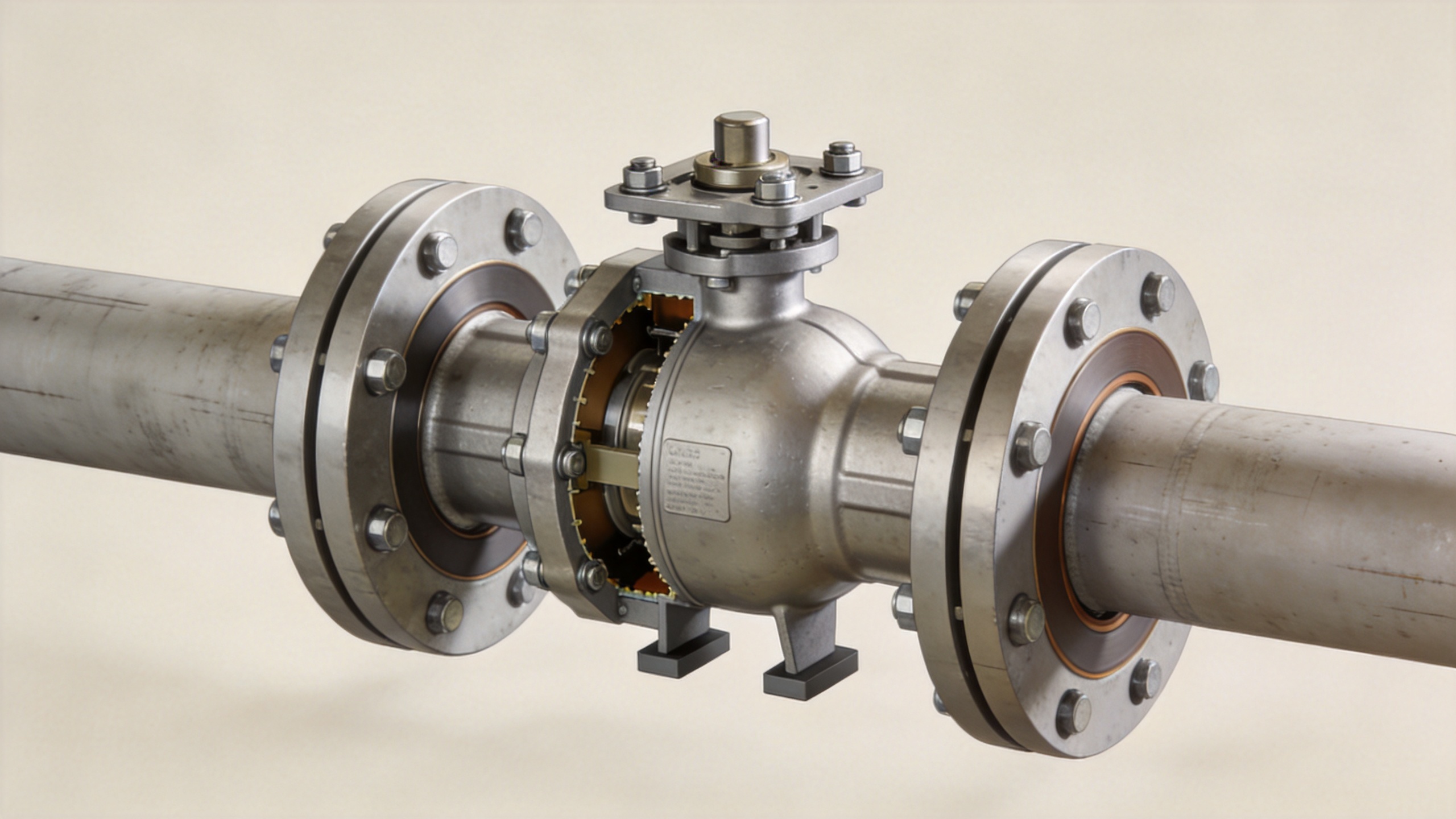
That benefit is conditional. Flange faces must be compatible, the gasket must suit the fluid and temperature, and bolts need an approved tightening sequence and target torque. Uneven bolt loading can create a leak path even when the valve body itself is sound. Installers should also avoid forcing misaligned pipe ends together with bolts; doing so can preload the Flanged Ball Valve body and reduce the margin available for operating loads.
2. Pressure class is a temperature-and-material decision
One common selection error is treating a flange class as a single pressure number. ASME B16.5 covers many pipe flanges and flanged fittings from NPS 1/2 through 24, with dimensions and pressure-temperature rating tables. The usable rating depends on the applicable material group and temperature, not just a Class 150, 300, or higher marking. A Flanged Ball Valve should therefore be reviewed as part of a matched pressure boundary: valve body, end flanges, gasket, bolting, mating pipe flanges, and the specified operating envelope.
Ask for the manufacturer's pressure-temperature data for the actual valve configuration. Confirm normal pressure, upset pressure, minimum and maximum temperature, fluid properties, and any cycling or thermal-transient conditions. If these facts are incomplete, a higher-looking class designation is not a substitute for engineering review.
3. Materials and seats set the service boundary
Strength is not only mechanical. Corrosion, chemical attack, abrasion, and temperature can change the long-term condition of a Flanged Ball Valve. Body and flange materials should be checked against the medium, external environment, and temperature range. The same is true for the ball, stem, seals, and seats. A material that is reasonable for clean water may require a different review for chlorides, solvents, slurries, steam-adjacent service, or corrosive process fluids.
Seat selection deserves particular attention because it affects shutoff behavior, operating torque, and the permissible temperature range. Do not infer a seat material or fire-performance feature from a general ball-valve description. Instead, include the requested seat material, anti-static or fire-safe requirements where applicable, and documentation requirements in the purchase specification.
4. Size changes the installation question
A 2 inch flanged ball valve and a 4 inch flanged ball valve may use the same basic principle, but they do not create the same installation task. The smaller valve may be easier to handle, while a larger valve can add more mass, a larger bolt circle, and greater consequences if the connected piping is misaligned. Neither size should be selected by nominal diameter alone.
For a 2 inch flanged ball valve, check the actual pipe schedule, flange drilling, face type, flow requirement, actuator clearance, and access for future bolt removal. For a 4 inch flanged ball valve, add a review of support locations, lifting method, vibration, pipe expansion, and whether the actuator or gearbox creates an off-center load. In both cases, verify bore configuration and allowable pressure drop against the duty rather than assuming that a larger passage automatically solves a system problem.
5. Body construction and stem details matter
Valve construction affects how a Flanged Ball Valve responds to pressure, assembly loads, and maintenance. Floating-ball and trunnion-supported arrangements have different ways of managing pressure-related forces. Two-piece, three-piece, and one-piece body designs also create different maintenance and sealing considerations. The appropriate choice depends on size, pressure, medium, maintenance plan, and the manufacturer's documented limits.
The stem area is another practical checkpoint. A well-considered design commonly includes features intended to retain the stem under internal pressure and to seal the stem through packing or other sealing elements. Yet a buyer should not assume the design details. Request the drawing, bill of materials, pressure rating, and operating-torque information for the proposed Flanged Ball Valve, especially if an electric or pneumatic actuator will be fitted.
6. Installation discipline protects the valve
A reliable Flanged Ball Valve installation begins before the bolts are tightened. Inspect flange faces, remove transport protection only when ready, confirm gasket type and orientation, and make sure the piping is independently supported. Align the flanges without using the valve as a lever or pipe-spreader. Then tighten bolts in a cross pattern using the approved procedure. Recheck accessible fasteners if the project procedure calls for it after thermal cycling.
- Confirm flange standard, class, face type, and drilling before delivery.
- Record medium, concentration, pressure, temperature, and operating cycles.
- Specify body, ball, stem, seat, gasket, and bolting materials.
- Provide pipe supports so valve and actuator weight do not distort the joint.
- Leave clearance for handle travel, actuator access, bolt removal, and inspection.
- Define the required inspection and pressure-test documents in the order.
7. Testing turns a specification into evidence
Documentation is part of strength because it confirms whether the supplied Flanged Ball Valve was examined and pressure tested under the required procedure. API 598 is commonly referenced for valve inspection and pressure testing, including shell and closure tests for relevant ball-valve types. Whether that standard applies to a particular order should be stated in the specification, along with any project-specific acceptance criteria, witness requirements, and certificates.
The useful question is not simply, “Is it tested?” Ask which test standard applies, which pressure boundary and seat tests were performed, what records will be supplied, and whether the configuration delivered matches the reviewed drawing. That gives maintenance and project teams traceable information rather than an unsupported performance statement.
A practical selection path
To select a Flanged Ball Valve, start with the process rather than the catalog. Define the medium and its changes over time, pressure and temperature range, nominal pipe size, flange standard and class, required shutoff duty, operation frequency, automation needs, available utilities, and maintenance space. Then verify the materials, construction, torque, supporting arrangement, and test documentation against those conditions.
A 4 inch flanged ball valve can be a sensible choice when the piping, flange pattern, flow requirement, and support plan all agree. A 2 inch flanged ball valve can be equally dependable when its smaller assembly is still matched to the correct gasket, bolting, and service limits. The durable outcome comes from matching the valve and joint to the pipeline—not from treating nominal size or a pressure-class marking as a shortcut.

 Hot News