
 EN
What Is a Ball Valve and Its Fundamental Design?
A Ball Valve is a quarter-turn valve that uses a drilled, rotating ball to start, stop, or—in selected designs—regulate fluid flow. From a valve application engineer’s perspective, the useful definition is not just “a valve with a ball inside.” The important question is how the ball, seats, stem, body, and operator work together under the actual medium, pressure, temperature, and cycling duty.
For isolation duty, a Ball Valve is valued because the handle, actuator, or gearbox can rotate the stem roughly 90 degrees between open and closed positions. When the bore through the ball aligns with the pipeline, flow passes through. When the solid side of the ball faces the passage, the valve closes. The simple motion makes the design familiar, but a reliable selection still depends on materials, sealing arrangement, bore style, and the operating conditions around them.
The Basic Working Principle of a Ball Valve
Inside a typical Ball Valve, the ball has a cylindrical flow passage called a bore. In the open position, the bore is in line with the pipe. In the closed position, it turns across the pipe axis. Seats on both sides of the ball create the primary shutoff seal. The stem transfers torque from the handle or actuator to the ball, while packing around the stem helps control potential leakage to atmosphere.
That sequence sounds straightforward, yet the selection process should connect the parts rather than list them separately. A soft seat can provide low-torque, tight shutoff in a suitable service, while a metal seat may be considered where process conditions demand a different temperature, wear, or media-resistance profile. The right answer is conditional: confirm the medium, contaminants, pressure-temperature range, required shutoff class, and expected number of cycles before settling on a seat and body combination.
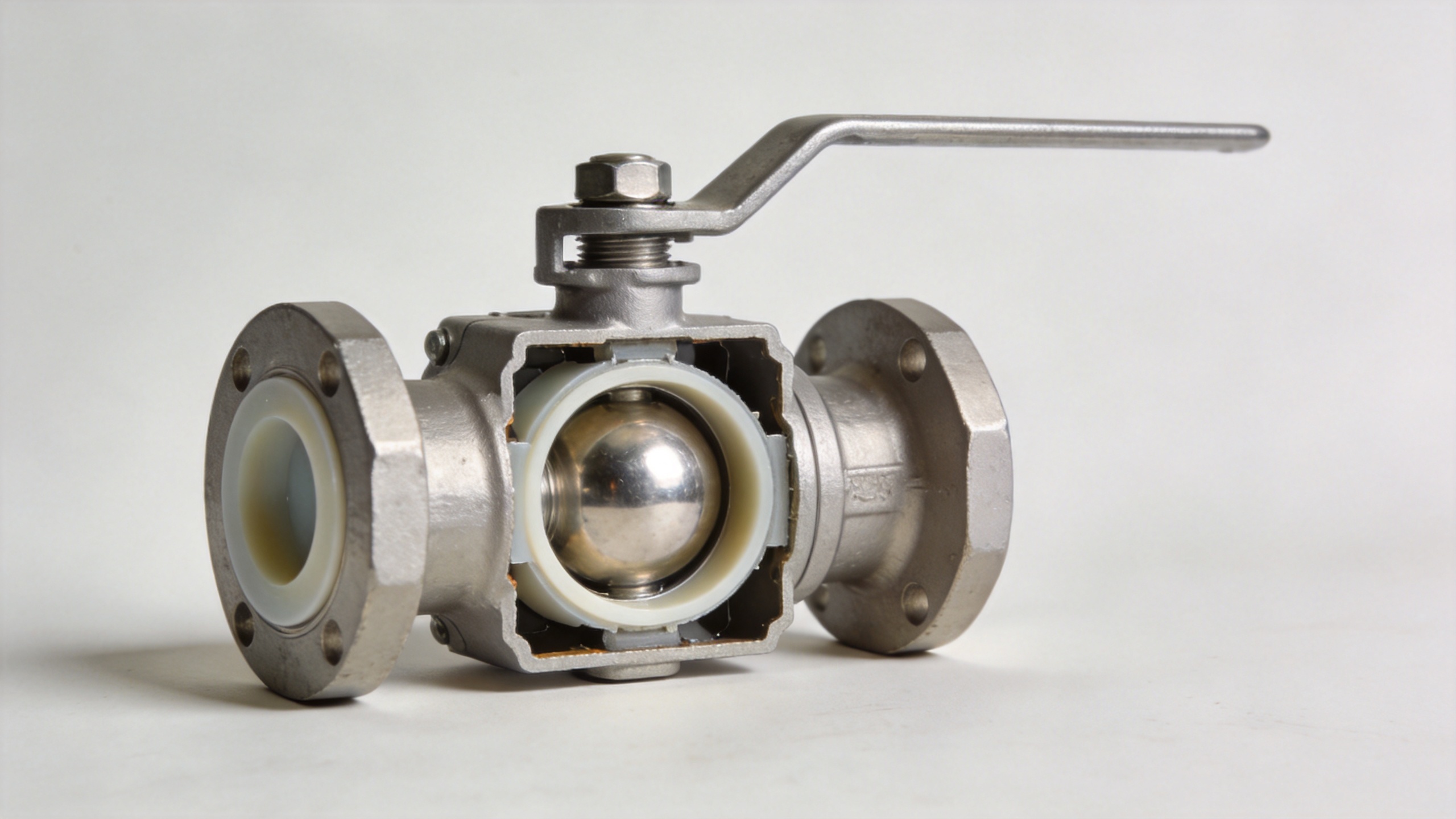
Fundamental Ball Valve Components
- Valve body: The pressure-containing shell with end connections such as threaded, flanged, welded, or other specified interfaces.
- Ball and bore: The spherical closure member and its flow opening. A full-port bore is intended to reduce restriction relative to a reduced-port configuration of the same nominal line size.
- Seats: Components that seal against the ball. Seat material should be assessed alongside the fluid, temperature, pressure differential, and wear risk.
- Stem and packing: The stem rotates the ball; packing and related hardware help manage stem-area sealing.
- Operator: A lever, gear operator, pneumatic actuator, electric actuator, or other drive arrangement supplies the needed torque and control behavior.
A useful procurement check is to avoid comparing only the nominal diameter or the initial price. Ask how the valve will be mounted, whether maintenance space is available, what happens if the medium changes, and whether manual or automated operation is actually required.
Floating Ball and Trunnion-Mounted Designs
Many smaller Ball Valve designs use a floating ball arrangement. The ball is supported by its seats and can move slightly downstream under differential pressure, helping it press against the downstream seat to seal. This arrangement can be practical for many ordinary isolation duties, but the pressure differential, size, seat load, and operating torque still need review.
A trunnion-mounted ball uses additional mechanical support above and below the ball. Rather than relying on the ball itself to move in the same way, the seat system is commonly arranged to move toward the supported ball. This general approach is often evaluated for larger sizes or higher-pressure duties where managing seat load and operating torque is important. It is not an automatic upgrade for every line; the project specification and supplier documentation should determine the applicable design.
Full Port, Reduced Port, and Bore Geometry
Bore geometry affects more than flow capacity. A full-port Ball Valve has a bore close to the connected pipe’s inside diameter, which can reduce flow restriction and may be relevant where pigging or pressure-loss considerations apply. A reduced-port valve has a smaller bore, often making the assembly more compact or economical for a suitable duty. Neither label alone proves performance; compare the actual bore, flow requirement, allowable pressure loss, and cleaning needs.
For oil, chemical, water-treatment, or process applications, also confirm the end connection, face-to-face requirement, body material, trim materials, and the test or design standard named in the purchase specification. API 608 is commonly referenced for certain metal ball valves used in petroleum, petrochemical, and industrial service, while API 6D may be relevant for pipeline applications. These references are examples, not blanket claims of compliance for every valve.
Where a V Port Ball Valve Fits
A v port ball valve uses a V-shaped opening or characterized ball/seat arrangement to provide more controllable flow behavior than a standard round-bore on-off Ball Valve. It can be considered when the process needs a degree of throttling rather than simple isolation, particularly at lower openings where a conventional full-bore design may change flow too abruptly.
However, a v port ball valve is not merely a standard Ball Valve with a different opening. The required control characteristic, pressure drop, cavitation or flashing risk, solids content, actuator sizing, and feedback requirements all matter. If the duty is only dependable open/close isolation, a conventional bore may be the more direct choice. If modulating control is essential, define the desired flow characteristic and operating range before requesting a V-port design.
What Does “Deadman Valve” Mean?
The term deadman valve usually describes a safety-oriented operating function: the valve is held in its operating position only while an operator maintains deliberate input, and it returns to a designated safe state when that input is released. It describes the control behavior, not a single universal internal Ball Valve construction.
A deadman valve function may be achieved through a spring-return handle, a pneumatic spring-return actuator, or another purpose-designed mechanism, depending on the system. Before specifying it, state clearly whether the safe position must be fail-closed or fail-open, what energy source is available, how quickly the system must respond, and whether the valve must meet site-specific safety procedures. The ball, seat, and actuator must be selected as a coordinated package.
A Practical Selection Checklist
- Define the medium, including solids, corrosiveness, viscosity, and possible temperature changes.
- Record normal and maximum pressure and temperature, plus the pressure differential across the closed valve.
- Decide whether the task is isolation, throttling, emergency shutdown, or a combination.
- Choose a bore style based on line requirements, pressure loss, and any cleaning or pigging need.
- Confirm seat, seal, body, and ball materials against the verified service conditions.
- Specify the operator: manual, geared, pneumatic, electric, or a fail-safe arrangement such as a deadman function.
- List the required standard, inspection, testing, documents, end connection, and installation constraints in the RFQ.
Key Takeaway
A Ball Valve fundamentally uses a bored ball rotating between seats, but the successful design is a system decision. Standard round-bore valves are often chosen for isolation, a v port ball valve may suit carefully defined control duty, and a deadman valve function addresses how the valve behaves when operator input is lost. By tying the internal design to the actual process conditions and verification requirements, buyers can request a configuration that is technically relevant rather than relying on the valve name alone.
 Hot News





