
 EN
How Does Butterfly Valve Save Space In Pipe Design?
When a plant room, treatment skid, or process line gets crowded, a Butterfly Valve can help reduce the length of the valve section between two pipe flanges. That benefit is real, but it is only one part of a workable layout. A Butterfly Valve is a quarter-turn device with a disc that rotates in the flow path, so its body can be much shorter in the pipe axis than many linear-motion valve forms. As a valve application engineer would assess it, the useful question is not “Is it compact?” but “What space does this Butterfly Valve save, and what clearance does the whole assembly still need?”
That distinction matters in drainage, water treatment, chemical process, and utility piping. A short body may reduce spool-piece length and support a tighter equipment arrangement. Yet actuator height, handle travel, disc clearance, bolt access, and maintenance routes can still control the final envelope. Good pipe design records each of those requirements before a Butterfly Valve is released for fabrication.
Why the Butterfly Valve body is short in the pipe run
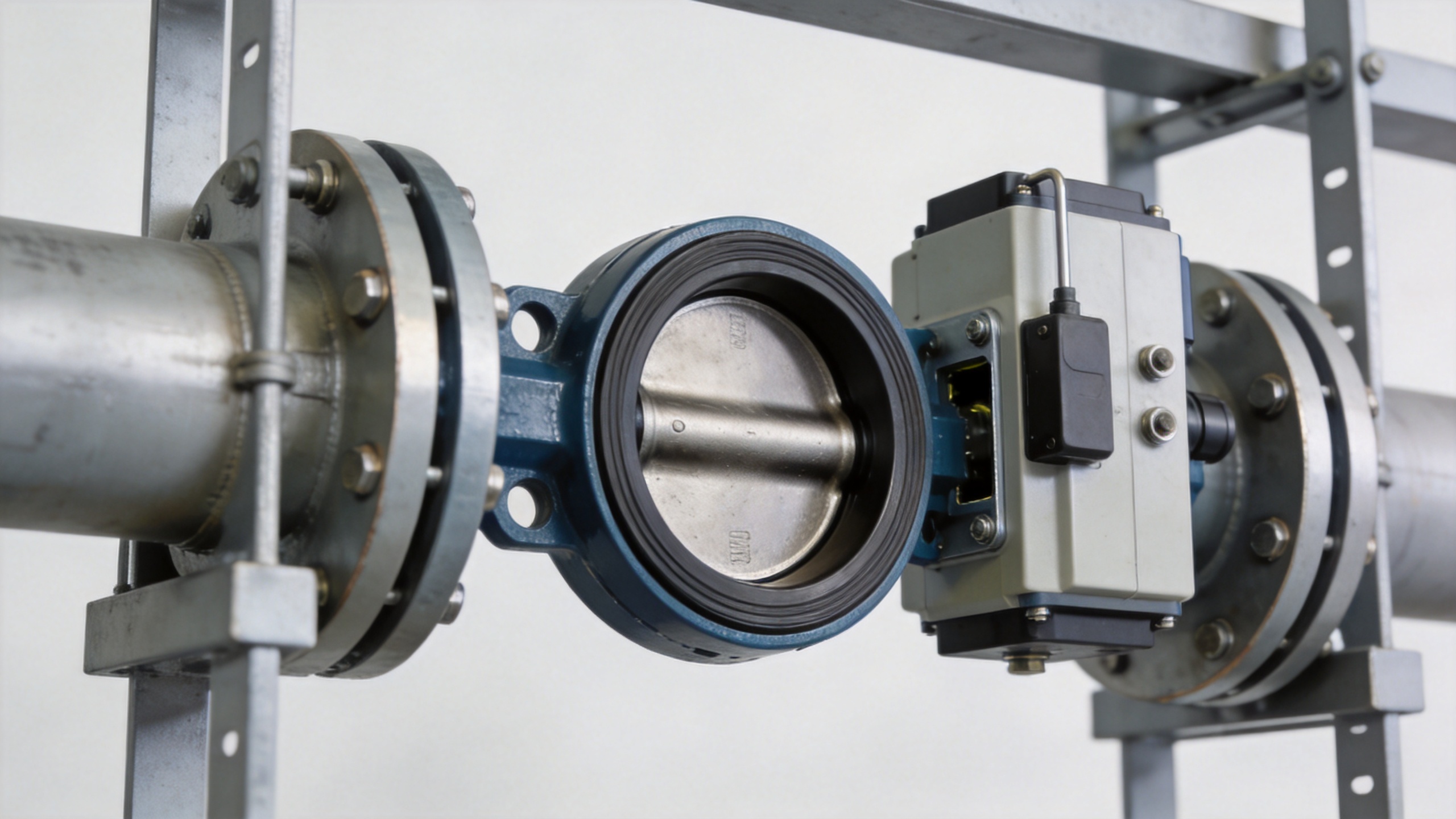
The main space benefit comes from face-to-face length: the dimension from one piping end of the valve to the other. A wafer-style Butterfly Valve sits between companion flanges, while a lug-style version uses threaded lugs to connect at each side. Both arrangements are generally designed around a thin body compared with many full-body, double-flanged, or multi-turn alternatives. That can shorten the straight-line space reserved for the isolation point.
In a repeatable module, a shorter Butterfly Valve body can reduce the distance between adjacent equipment nozzles or allow a branch to fit within a narrower rack bay. It can also reduce the number or length of spool sections that must be detailed, fabricated, lifted, and aligned. These are layout advantages, not a universal declaration that one valve type is suitable for every medium or shutoff duty.
Do not compare nominal size alone. The selected pressure class, connection standard, liner or seat arrangement, and body style influence the actual drawing dimensions. API 609 and EN 593 are examples of documents engineers may need to review, but the certified drawing and project specification for the selected Butterfly Valve remain the decision documents.
Where the saved length can improve a piping layout
Equipment skids and packaged systems
On a compact skid, the Butterfly Valve can make it easier to place isolation points close to pumps, filters, tanks, or manifolds without extending the skid frame solely for valve length. This can be useful where several branches share a limited footprint. The gain should be recorded as a dimensional check, not as an assumed performance benefit.
Pipe racks and parallel headers
Parallel lines often need consistent offsets for supports, insulation, instrument tubing, and access. A Butterfly Valve with an appropriate short face-to-face dimension may help a designer keep a branch within the available bay. It can also simplify the route when two flange faces must land near existing steelwork. The designer still needs enough room to tighten fasteners and remove the valve during service.
Retrofit work
A Butterfly Valve can be attractive when a replacement must fit between existing flange faces and the line cannot easily be rerouted. Before treating it as a drop-in solution, verify the installed dimension, flange compatibility, disc travel, pressure-temperature conditions, and the system's isolation expectations. A compact body does not remove those checks.
Compact body does not mean a small installed envelope
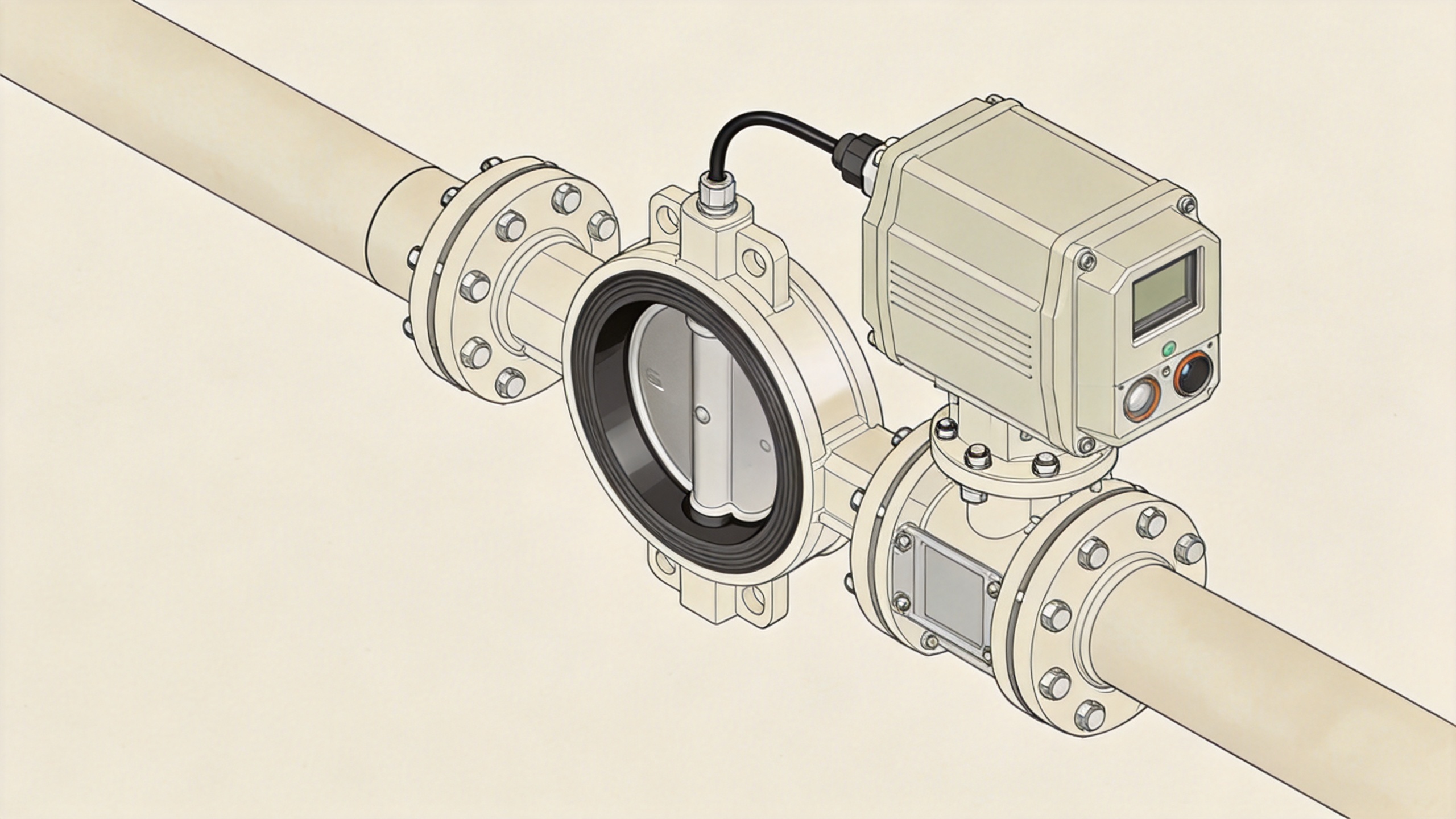
The pipe-axis length is only one dimension. With a manual lever, the Butterfly Valve needs a swing zone for operation. With a gearbox, there must be access to the handwheel and mounting hardware. With a pneumatic or electric actuator, the assembly may extend above, beside, or beyond the body. Cable entries, air fittings, position indication, and local controls also need a route that technicians can reach.
This is particularly relevant when automation is planned. A submersible electric actuator is a purpose-designed drive concept that should be evaluated as part of the valve-and-environment assembly, not selected because the valve body is thin. Confirm ingress protection, mounting connection, power and signal routing, torque requirements, service access, and the actual installation orientation. The control package may consume more layout space than the Butterfly Valve body saves.
Disc movement is another constraint. The rotating disc occupies the bore when open and passes through the flow area as it closes. Check that nearby reducers, elbows, strainers, linings, and mating components do not interfere with the selected Butterfly Valve configuration. The pipe system, actuator, and control signal are part of the same decision, rather than independent additions.
What a designer should compare before selecting a Butterfly Valve
- Face-to-face dimension: Obtain the supplier drawing for the exact size, style, rating, and connection standard.
- Outside envelope: Map body diameter, flange hardware, actuator or handle, cable glands, air tubing, and position devices.
- Service clearance: Leave room for bolting, inspection, adjustment, and removal; a compact Butterfly Valve still requires maintenance access.
- Flow and shutoff duty: Review medium, solids content, pressure, temperature, flow direction, cycling frequency, and required leakage class.
- Structural support: Confirm that the line, actuator weight, and nearby supports are coordinated rather than relying on flange bolts to carry unintended loads.
These checks turn a general size advantage into a usable layout decision. The same nominal Butterfly Valve can have a different envelope when its material, seat, flange arrangement, or drive package changes. Do not start by asking which valve is smaller; start by listing the process and access conditions that define the installation.
How does a Butterfly Valve compare with other layout options?
For a short in-line envelope, a wafer or lug Butterfly Valve is often worth comparing early in the layout process. A full double-flanged body may require more axial space. A gate, globe, or other multi-turn configuration may also bring a different body length and operating clearance. However, layout compactness is only one selection criterion. The required control behavior, allowable pressure loss, media compatibility, isolation duty, maintenance plan, and project standard can lead to another choice.
For example, a designer who is also asking what is a solenoid valve is usually examining a different control function. A solenoid valve uses an electromagnetic coil to actuate a small internal mechanism and is commonly associated with pilot, utility, or control-fluid duties. It is not automatically an alternative to a process-line Butterfly Valve. The comparison should begin with the required fluid path, size, control signal, and duty cycle.
A practical layout-review sequence
- Mark the available pipe-axis gap and identify nearby steel, equipment, and branch connections.
- Place the selected Butterfly Valve using the exact manufacturer drawing, not a generic CAD block.
- Add the handle, gearbox, or actuator envelope and show cable or air connections.
- Test opening, closing, bolt tightening, lifting, and removal access in the model or field survey.
- Review process suitability separately from space: medium, pressure, temperature, flow, cycles, and sealing requirements still govern the choice.
- Document any remaining unknowns in the enquiry or specification so the final configuration can be checked.
For industrial valve and automation discussions, Guangzhou Fols Valve Technology can help organize the technical conversation around operating conditions, control method, connection details, and maintenance access. That is more useful than treating compactness as a stand-alone claim.
Conclusion
A Butterfly Valve saves space chiefly because a suitable wafer or lug body can occupy less face-to-face length in a piping run. That can support denser skids, headers, and retrofit layouts. The final design still needs room for the actuator or operator, disc movement, flange hardware, and maintenance. Use the exact Butterfly Valve drawing alongside the piping model, then confirm the process duty before converting a compact concept into a released installation.
 Hot News





