
 EN
Why Control Valve Enhances Safety In Industrial Automation Systems
In an automated plant, a Control Valve is not simply a component that opens and closes. It is the final device that turns a controller command into a physical change in flow, pressure, temperature, or level. When process conditions drift outside their intended operating window, the response of a Control Valve can help keep the process stable and give operators time to act. That is why valve selection belongs in the same safety conversation as instruments, alarms, logic solvers, relief devices, and operating procedures.
From an industrial valve application engineer’s perspective, the useful question is not whether one Control Valve is safer than another in isolation. The question is whether its body, trim, actuator, signal behavior, and failure position fit the actual medium, pressure, temperature, flow range, and control duty. A modest-looking mismatch can turn a well-designed automation loop into a source of unstable operation.
How a Control Valve turns automation into a physical safety response
A control loop compares a measured process value with a target and then sends an output signal to a final element. In many industrial loops, that final element is a Control Valve. By changing the flow passage, the valve can moderate feed flow, cooling-water flow, steam flow, or another process stream. The result may be a more controlled pressure, temperature, liquid level, or flow condition.
This matters because process deviations rarely stay in one place. Excess flow can affect downstream level; a temperature rise can change pressure; a blocked outlet can alter the entire balance of a line. A correctly specified Control Valve gives the control system a usable means of correction before the deviation develops further. It does not replace engineering safeguards, but it is often the point where the automation strategy becomes mechanical action.
For hazardous processes, valves, emergency shutdown systems, relief and vent systems, and controls are commonly treated as connected parts of the process-safety picture. The design review should therefore consider the Control Valve with its upstream and downstream equipment rather than treating the valve body as a standalone purchase item.
Four safety contributions of a Control Valve
1. Keeping critical variables within an operating window
The everyday safety value of a Control Valve often begins with regulation. A valve that has appropriate sizing and flow characteristics can respond smoothly across the expected load range. If it is too large, small signal changes may cause abrupt process changes. If it is too small, the loop may have too little authority when demand rises. Either condition can make tuning difficult and leave operators dealing with frequent excursions rather than a stable process.
2. Supporting a defined fail position
Safety is also shaped by what the Control Valve does when power, air, signal, or hydraulic energy is lost. Depending on the process hazard, the desired response may be fail closed, fail open, or fail in place. There is no universal answer. Closing a fuel line may be appropriate for one duty, while opening a cooling-water path may be appropriate for another. The fail action must come from a hazard review and be confirmed alongside actuator type, spring action, solenoid arrangement, air supply, and the control-system logic.
3. Limiting pressure-related exposure in the right application
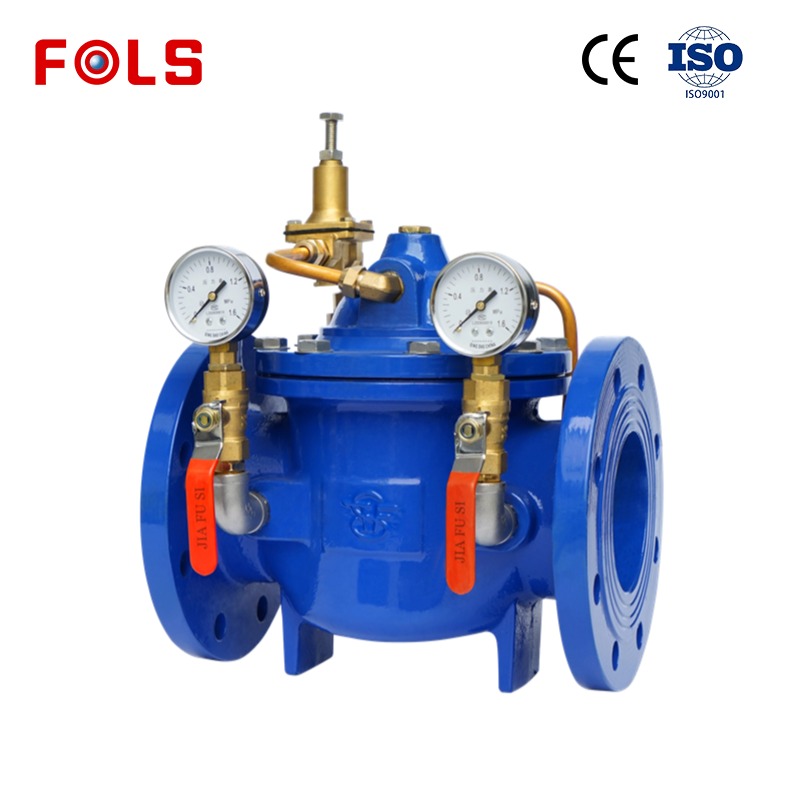
A pressure reducing regulator can be used where downstream pressure needs to be reduced or maintained by a self-acting device. In a more integrated automated loop, a Control Valve may regulate pressure using a transmitter and controller. These are related but different duties. A pressure reducing regulator is not a substitute for a relief device, and a modulating valve is not automatically a safety shutdown device. Clear separation of these functions helps engineering teams assign the right safeguard to the right scenario.
4. Managing temperature-related flow paths
Some systems need a controlled route for fluid as temperature changes. A thermal bypass valve may direct flow around equipment under defined thermal conditions, while a Control Valve can modulate a heating or cooling stream based on the measured process temperature. In either case, the safety question is practical: what happens during startup, low-load operation, sensor loss, actuator failure, or a sudden change in heat load? A design that only works at normal steady state leaves important conditions unexamined.
Why valve hardware and automation details must be reviewed together
It is tempting to select a Control Valve by nominal size and pressure class alone. Those items matter, but they do not explain how the assembly will behave in service. The review should connect the valve body and trim to the actuator, positioner, air set, feedback signal, control narrative, and maintenance access. A single pressure rating has meaning, but its relationship to the medium, line conditions, and actuator arrangement is more important.
- Process medium: Confirm compatibility with the fluid, contamination level, corrosion risk, and phase behavior.
- Operating envelope: Record normal, minimum, maximum, startup, shutdown, and upset pressure, temperature, and flow conditions.
- Valve behavior: Check the selected flow characteristic, shutoff requirement, cavitation or flashing exposure, and expected control range.
- Actuation: Define the energy source, failure position, stroking time, signal loss behavior, and manual override requirements.
- Verification: Establish inspection, functional-test, calibration, and maintenance responsibilities before commissioning.
For an application assigned a safety function, the complete valve assembly and its place in the safety-instrumented function require a formal engineering assessment. A claimed performance level cannot be inferred from the nameplate of a Control Valve alone. The loop architecture, diagnostics, testing interval, common-cause exposure, and documented assumptions all affect the final decision.
Common selection mistakes that weaken safety performance
One frequent mistake is specifying a Control Valve only for normal flow. A line may operate most of the time in a narrow range, yet startup, low demand, or abnormal pressure conditions may require very different valve travel. Another is selecting a fail position because it sounds familiar rather than because it matches the consequence of lost utility or signal.
Teams can also confuse regulation with isolation. A Control Valve that performs well in continuous throttling may not meet the shutdown, isolation, leakage, or response-time requirements of a separate protective function. Similarly, a pressure reducing regulator and a thermal bypass valve should be evaluated for their own defined duties rather than being assumed to cover every process deviation.
The more reliable approach is to move from a valve name to the conditions that determine suitability. Before selecting equipment, list the medium, process objective, pressure and temperature limits, required response, failure state, control signal, installation location, and test method. That checklist creates a better basis for technical discussion than a generic request for “an automation valve.”
A practical safety review before commissioning
- Map each Control Valve to the variable it influences and the consequence of incorrect movement.
- Confirm the intended fail position against the process hazard review and utility-loss scenarios.
- Verify that valve sizing covers normal operation and credible transient conditions.
- Review actuator, positioner, air supply, wiring, feedback, alarms, and interlocks as one functional chain.
- Document inspection and functional-test steps, including who records the results and how changes are controlled.
Industrial automation becomes safer when the Control Valve is treated as part of a verified system, not as an isolated mechanical item. By matching the valve and actuator to real operating conditions, defining what happens on loss of energy or signal, and testing the complete response path, engineering teams can build a clearer and more manageable safety strategy.
 Hot News





